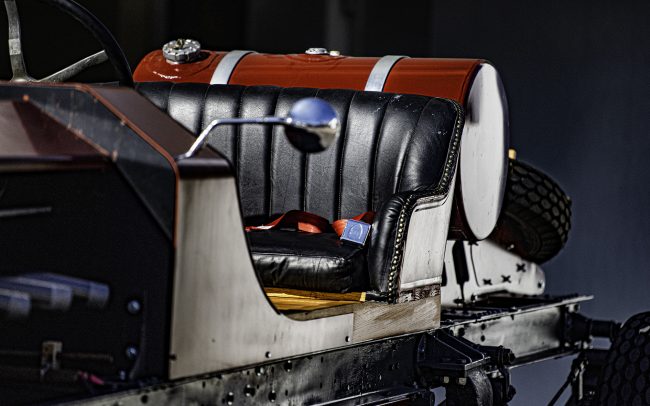
101 years, 1001 miles and a story worth to share….
F6- Seagrave T-Head. A Giant Engine Far Ahead Of Its Time
It has taken long sessions in the internet to obtain information about the Seagrave Firetrucks of the 1910…1920. This site intends to show you the point of view of the manufacturer to explain in detail the function of the powerful engine.
The first motorists must have had a novel confrontation with this sophisticated new technology.
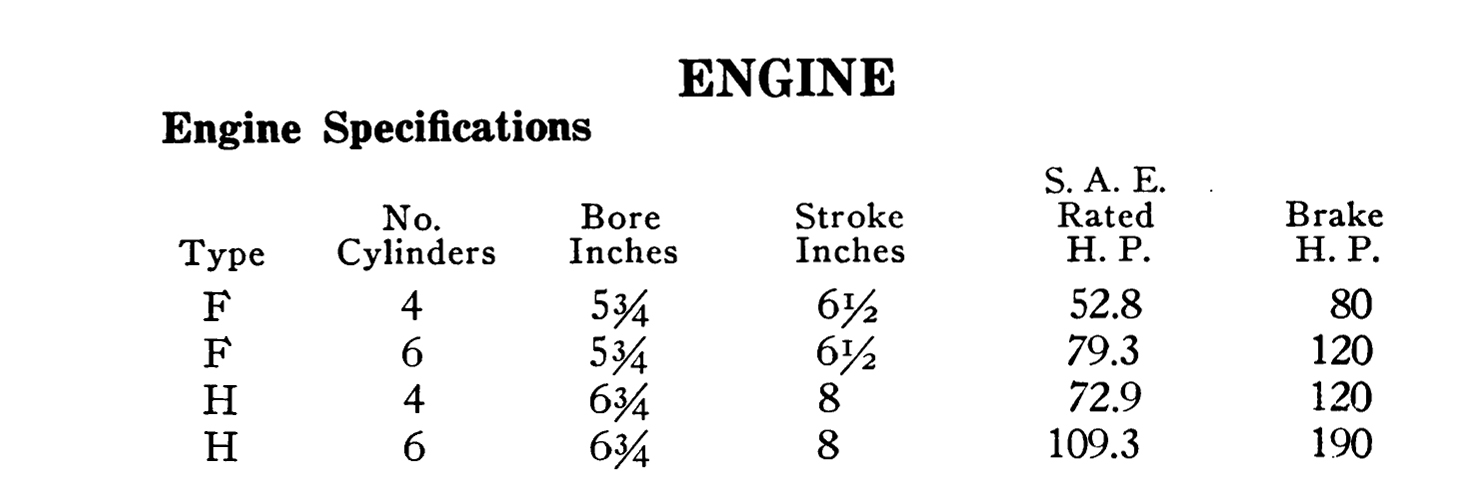
over 1000 lbs torque
1/min 1700
1013 cci / 16.000 ccm displacement
3 ignition circuits ( 2 magnet,1 distributor)
Marvel-Schebler X1 series brass carburetor
60 mp/h
100l /100km mileage (…)
All engines used in Seagrave apparatus are of our own make and have the same design. All valves, valve caps, pistons, connecting rods and such parts are interchangeable—as far as new ones are concerned, but whenever they have been removed temporarily, from the engine, they should be replaced in the same cylinder.
If, for any reason, the engine has been dismantled, will be noticed that the bearings and other parts are numbered in such way that they may be replaced in the exact position in which theywere found, and where such markings do not exist, the mechanic can use his own marks. If desired to insure the proper replacement. If the piston rings are removed from the piston, care should be taken to replace them in the same position, and in the same order, in which they were originally found; also. the pistons should be returned to the cylinders from which they were withdrawn. All gudgeon pins and lock-screws are placed toward the front end of the engine.
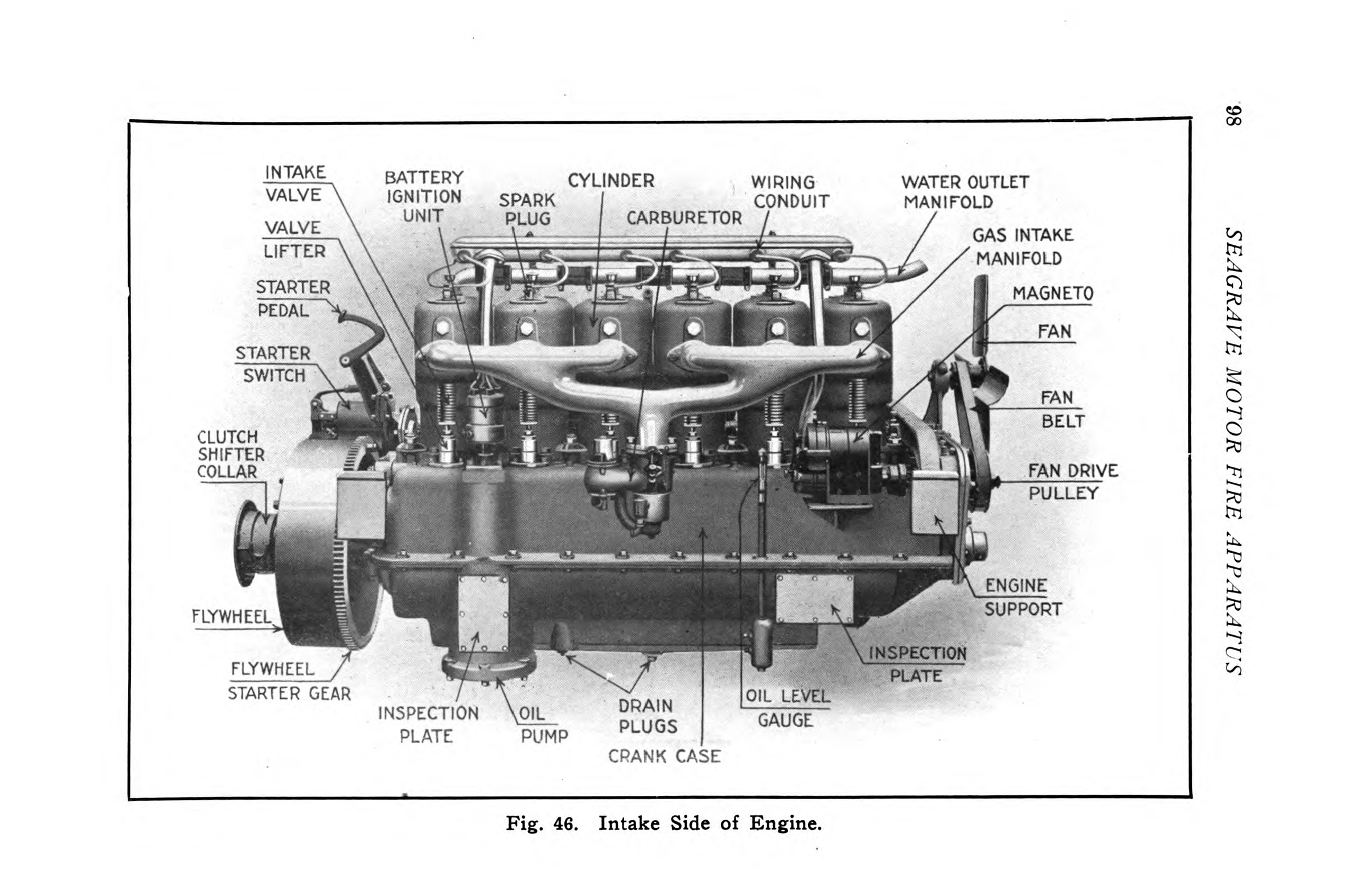
Crank Case
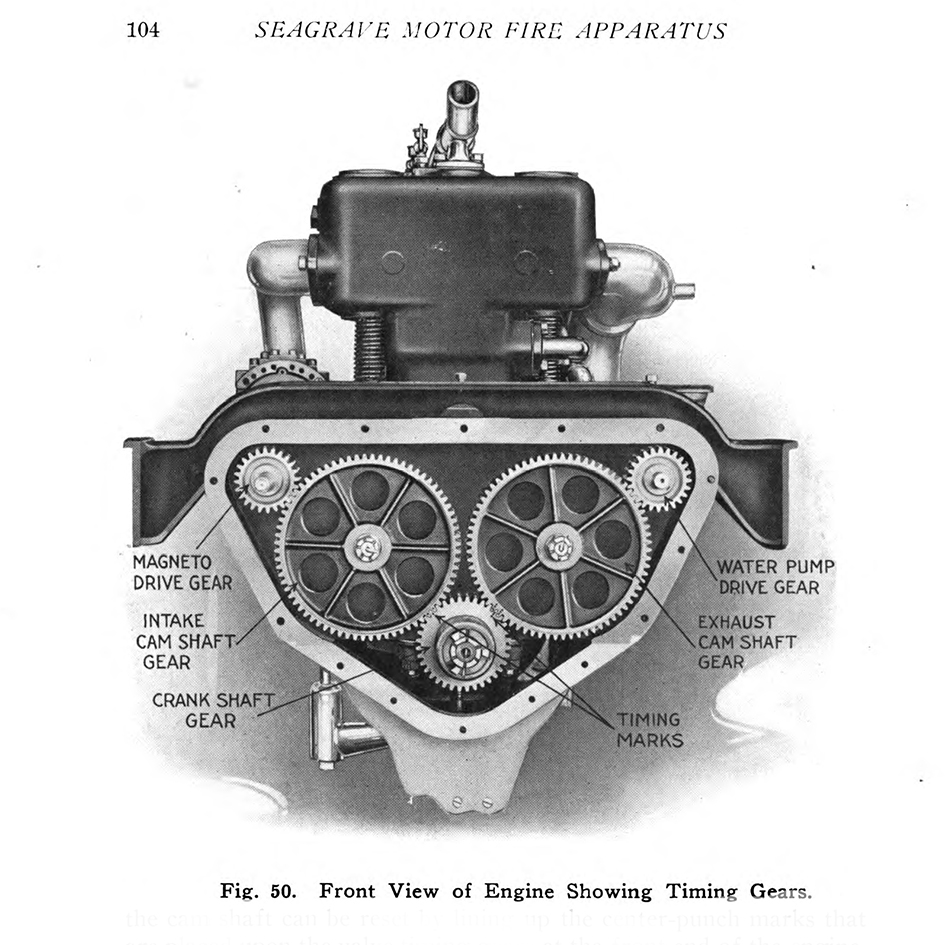
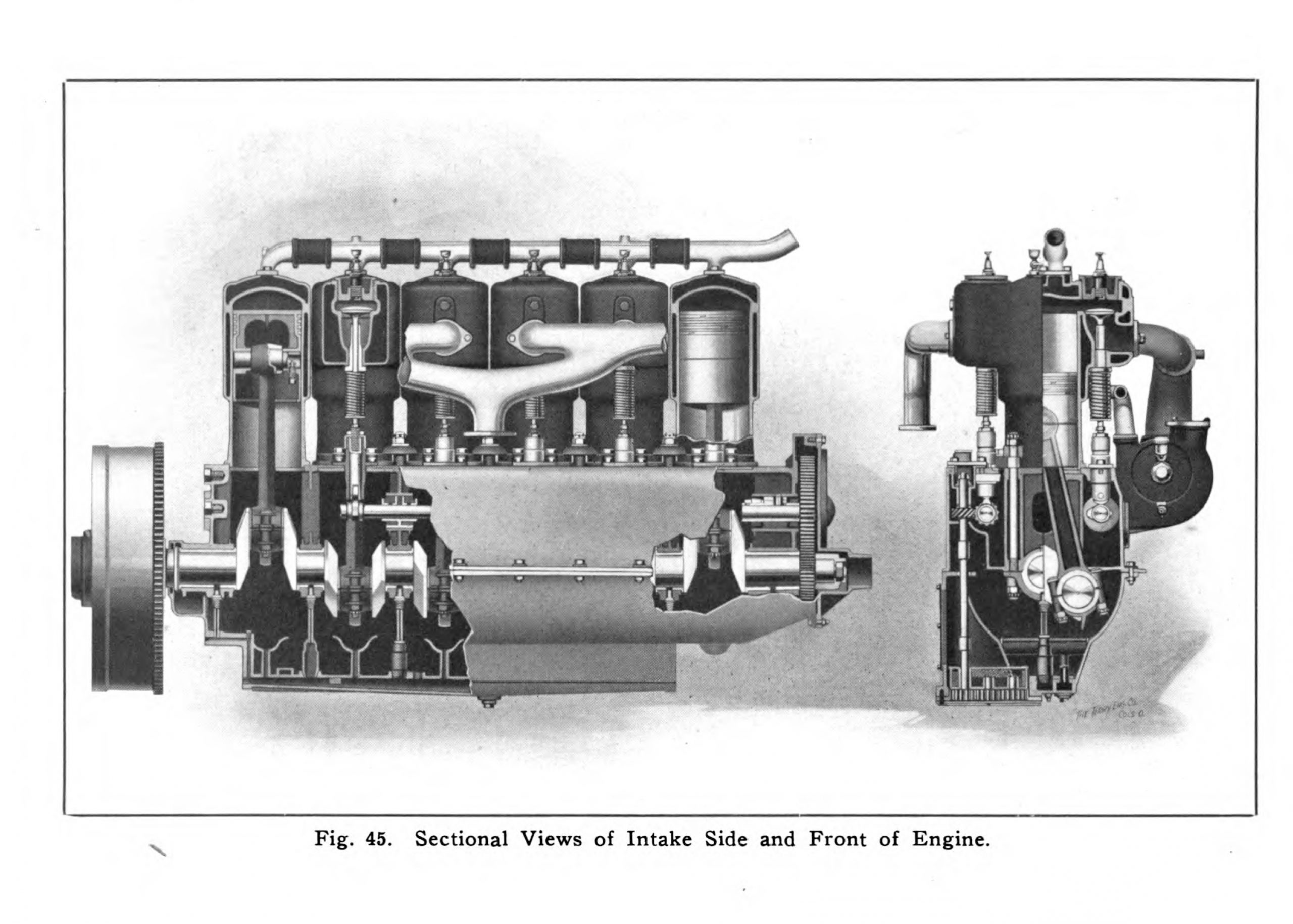
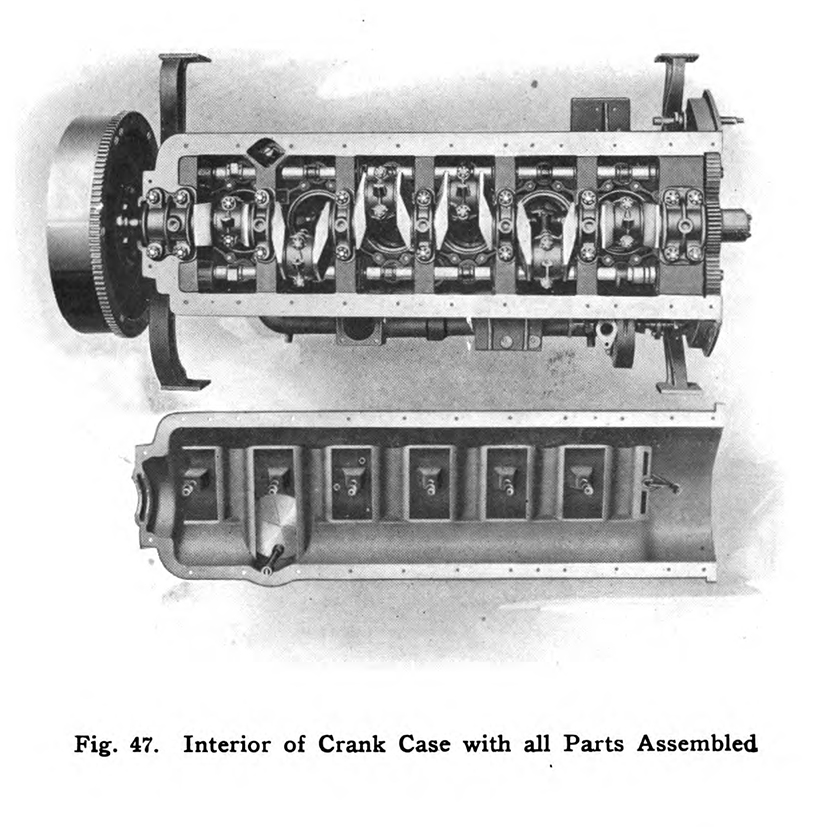
The crank case is divided horizontally into two sections. The uppermost or main section forms the engine base and contains the cam shafts and seats for upper halves of the crank shaft bearings. The lower halves of the crank shaft bearings are held by rigid caps bolted to the upper crank case section. A forward extension con tains the gears for operating the cam shafts, water pump and generator, magneto and fan.
Where the magneto drive shaft and water pump drive shaft extend from the gear case, packing boxes are provided to prevent leakage of oil. These should be adjusted when excessive leakage occurs, but be very careful not to make them tighter than is abso lutely necessary to correct the trouble.
The bolts holding the crank shaft bearing caps extend thru the top of the crank case, and, also, hold the cylinders, so that when the explosions take place, the strain is taken up by the bolts instead of thru the crank case.
All the working parts of the engine, excepting the oil pump, are carried by the upper half of the crank case and can be inspected by removing the bottom half. The engine is mounted upon two supports which are bolted directly to the side members of the frame. Both of these are attached to the upper part of the crank case. The rear support is bolted solidly to the crank case, but the front one is attached by a trunnion so that the engine is free to turn in front support. This the frame without The trunnion pin should oiled frequently that binding will occur this point, which would defeat the object for which the three-point suspension was intended.
The motor support bolts should be examined frequently and kept tight so that no movement occurs between them and the frame, also see that the rear support is rigidly attached to the crank case.
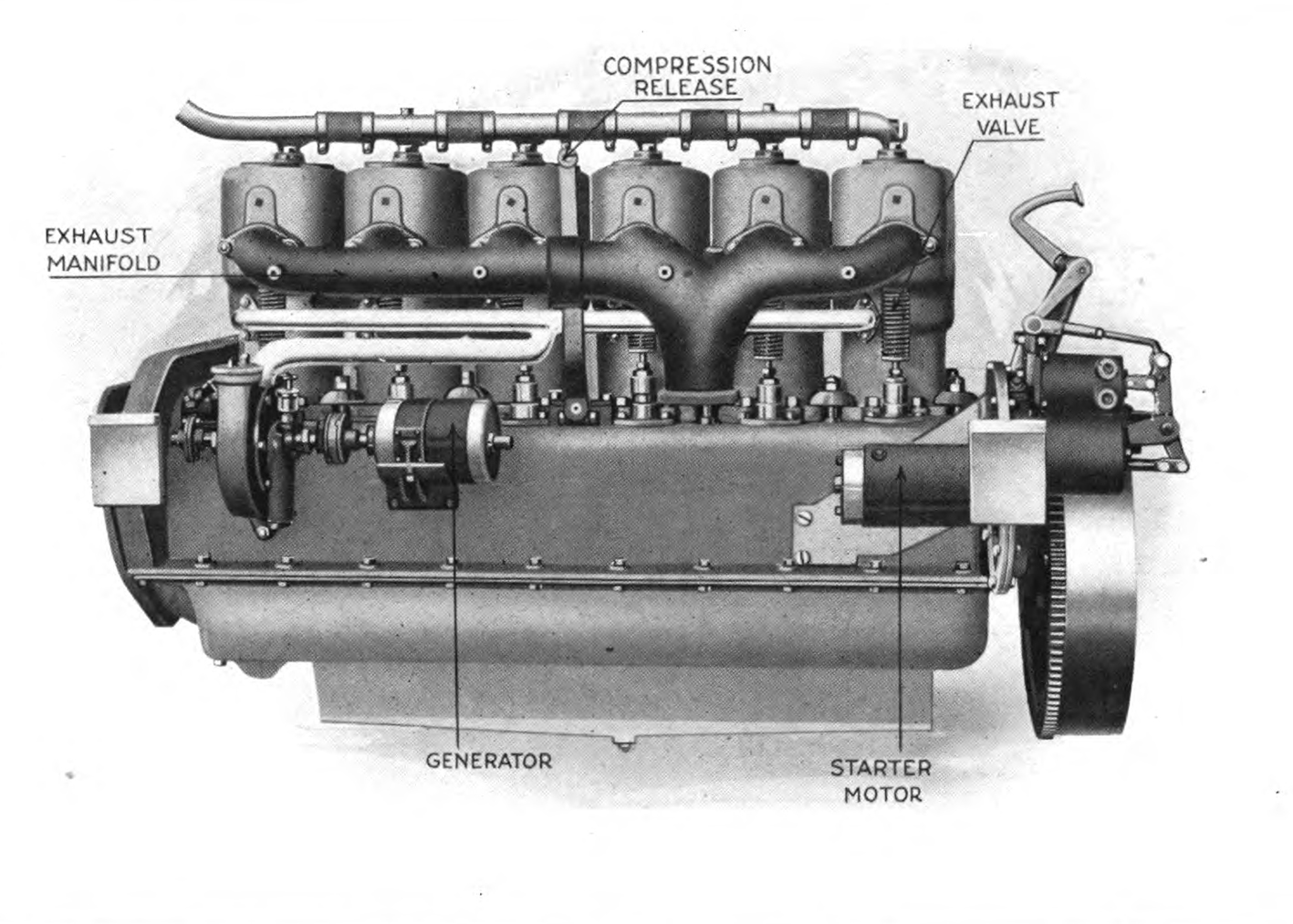
Compression Release
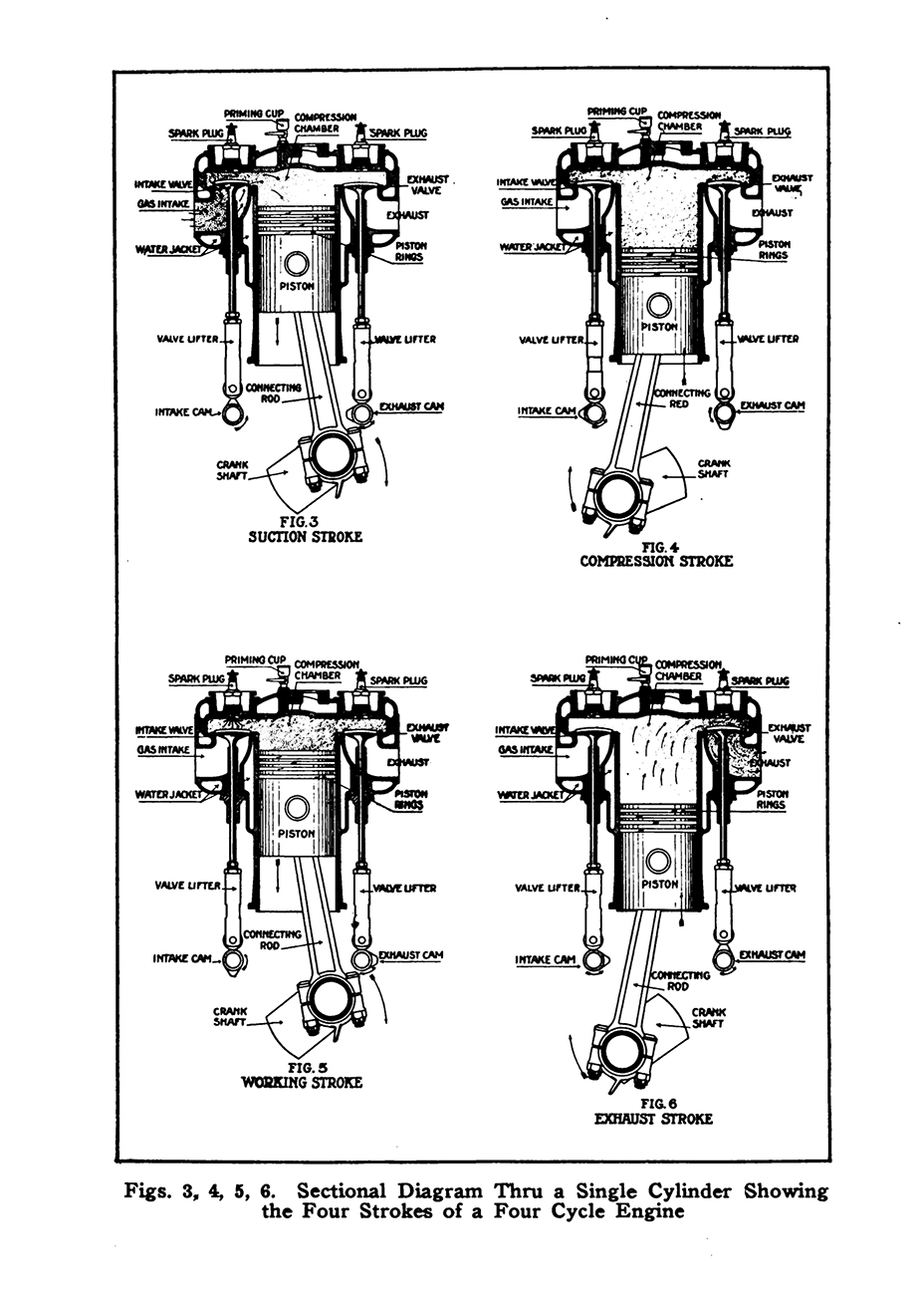
The resistance of the compressed charge in the cylinders is so great that it is difficult to crank the engine by hand unless part of the charge released. This accomplished by small cam at theback of each exhaust cam. To release the compression, the com pression release grip on the dash pulled out. This operates lever attached to the exhaust cam shaft which moves the cam shaft forward so that the compression release cams are under the valve lifters. Then when the engine cranked, the small cams lift the valves while the pistons are on their compression strokes, thereby releasing portion of the charge. The quantity of vapor to be compressed is thus reduced, hence there less resistance to be overcome.
As soon as the engine starts, the compression release must be closed: otherwise. the engine cannot develop full power.
When using the self-starter, the compression should not be released because the re-action of the compressed charge in one cylinder assists in compr sing the following one, consequently requires less energy for operat the starting motor.
Engine Bearings
The main and conecting rod bearings are of the laminated type, consisting of steel shlls lined with babitt metal.
Each bearing is in halves with liners for adjustments between them.
The adjustment of engine bearings is very important and should be made by experienced mechanics.
The excellent construction of our engines together with the first-class material used in our bearings, make adjustments necesary only at large intervals.
Each cam shaft supported by three bronze bearings in the 4-cylinder engine and four bronze bearings on a 6 -cylinde engine.
The cam shaft complete with bearings can be removed thru the front timing gear case after the screws holding have been removed.
All other bearings are bronze bushings that can easily bee replaced.

Compression
When the compression is weak or not equal in all cylin(lers, it is usually caused by the valves not seating perfectly. This may be caused by: (l) not enough clearance between valve lifters and valve stems; (2) carbon deposit on valve seats; (3) valve stems sticking in the guides, or valve plugs or spark plugs leaking.
Valve Grinding
The first thing to do is to remove the spark plugs and caps overthe valves to be ground, then remove each valve spring by raising the washer at the bottom which will release the two locks, so that they can be removed. The valve can now be lifted out of the cylinder.
Clean the valve all over, scraping the carbon from it as well as scraping the seat and parts of the engine immediately surrounding the valve seat to remove all carbon. A rag or waste should be placed in the passage between the valve chamber and the cylinder so that “dirt and valve grinding compound will not find its way to the highly polished surfaces of the cylinder and piston.
After these preparations have been made, the seat of the valve
should be covered with some abrasive,compounds are preferable for this purpose. but if they cannot be obtained, a mixture of oil with fine emery or ground glass may be used. Most of the regular grinding compounds that are sold for automobile valves, are put up with two or more grades in the same box. The valve seat should be covered lightly with the coarser compound, then replace the valve in the engine, and rotate it back and forth with a screw-driver placed in the slot on top. The grinding is usually done by rotating the screw-driver back and forth between the palms of the hands and lifting the valve from its seat at frequent intervals, turning it slightly each time so that new points of contact are being ground together.
As fast as the grinding compound wears out. it should be replaced with new. As long as the same grade is being used, it is not neces sary to clean the different parts.
Frequent inspection should be made of the progress of the work, and the cutting compound removed from both the valve and stem to determine their condition. When both these parts show clean, bright, smooth surfaces, the valve has been ground sufliciently. It should then be ground for a few moments with a lighter or finer
Compression
When the compression is weak or not equal in all cylin(lers, it is usually caused by the valves not seating perfectly. This may be caused by: (l) not enough clearance between valve lifters and valve stems; (2) carbon deposit on valve seats; (3) valve stems sticking in the guides, or valve plugs or spark plugs leaking.
Valve Grinding
The first thing to do is to remove the spark plugs and caps over the valves to be ground, then remove each valve spring by raising the washer at the bottom which will release the two locks, so that they can be removed. The valve can now be lifted out of the cylinder.
Clean the valve all over, scraping the carbon from it as well as scraping the seat and parts of the engine immediately surrounding the valve seat to remove all carbon. A rag or waste should be placed in the passage between the valve chamber and the cylinder so that “dirt and valve grinding compound will not find its way to the highly polished surfaces of the cylinder and piston.
After these preparations have been made, the seat of the valve should be covered with some abrasive, compounds are preferable for this purpose. but if they cannot be obtained, a mixture of oil with fine emery or ground glass may be used. Most of the regular grinding compounds that are sold for automobile valves, are put up with two or more grades in the same box. The valve seat should be covered lightly with the coarser compound, then replace the valve in the engine, and rotate it back and forth with a screw-driver placed in the slot on top. The grinding is usually done by rotating the screw-driver back and forth between the palms of the hands and lifting the valve from its seat at frequent intervals, turning it slightly each time so that new points of contact are being ground together.
As fast as the grinding compound wears out. it should be replaced with new. As long as the same grade is being used, it is not neces sary to clean the different parts.
Frequent inspection should be made of the progress of the work, and the cutting compound removed from both the valve and stem to determine their condition. When both these parts show clean, bright, smooth surfaces, the valve has been ground sufliciently. It should then be ground for a few moments with a lighter or finer compound in order to smooth and polish the surfaces. Then wipe all of the compound from the different parts and clean them with gasoline. Remove the mg or waste from the cylinder and replace the valve and other parts in a reverse order to that in which they were removed
TATSU
The Ignition System


Magneto
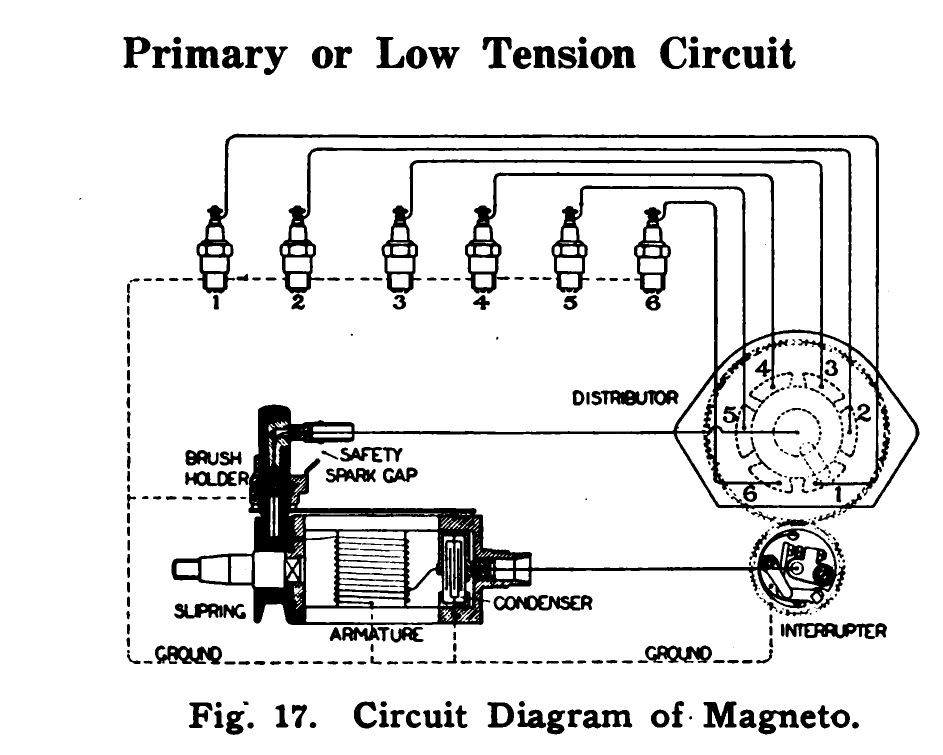
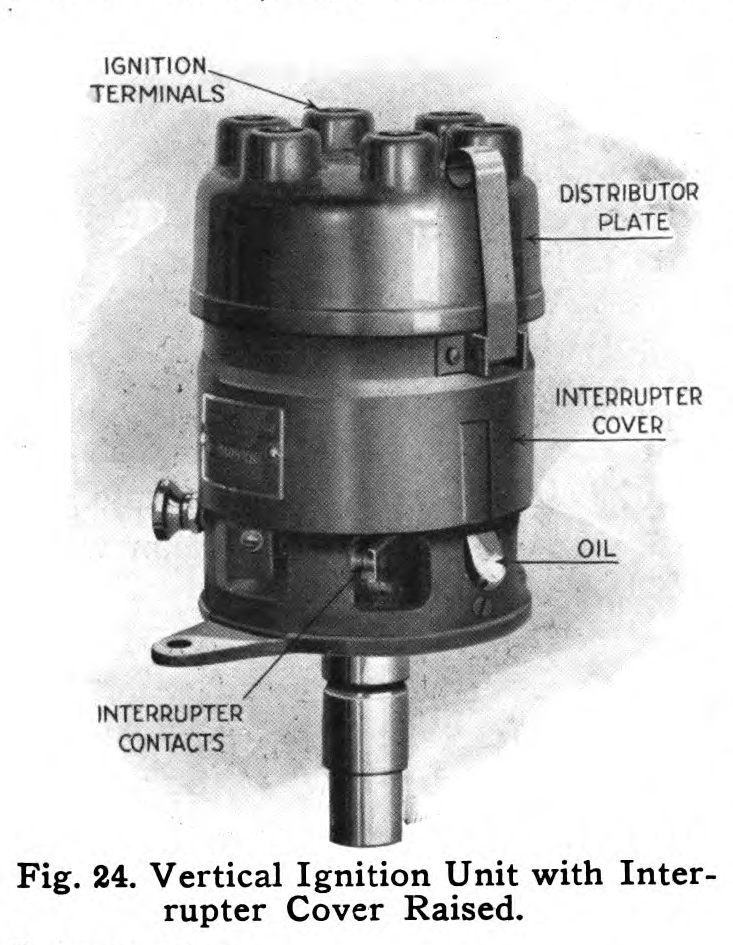
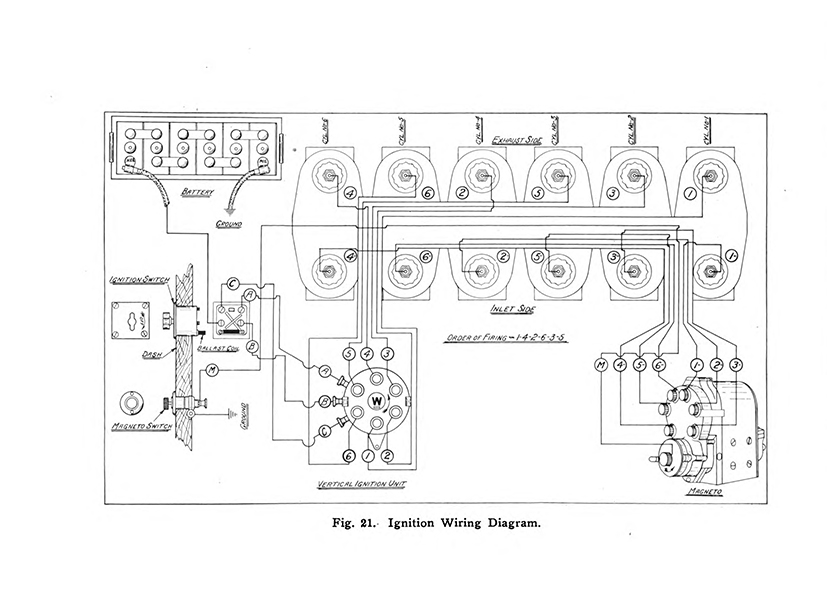
The purpose of the ignition system is to furnish an electric spark in each of the cylinders in the order of their firing. The spark is so timed as to ignite the compressed charge of gas in the combustion chamber at the right instant. The electric current is furnished by a battery or magneto. In Seagrave apparatus both systems are provided, so they may be used independently or together. The magneto is the source of spark used in regular running, and is wired to one set of spark plugs. For starting and emergency use, the storage battery supplies current to a second set of spark plugs thru a vertical ignition unit, consisting of a timer, induction coil and distributor.
Distributor Adjustments and Settings
Interrupter
Interrupter Contacts: The contact screw should adjusted with screw driver that with cam segment against the bumper shown Fig. 22, the contacts are open 008 inch.
Inspection Interrupter Contacts: An inspection the interrupter contacts should made every four months. The gap should be checked with the feeler gauge furnished with the outfit.
If the contacts show pitted or irregular surfaces, they should be smoothed up with a very fine file, making certain that the surfaces come together squarely after final adjustment has been made.
Distributor Brushes: These should slide freely in their holder and the spring should push the top brush out so as to extend from the holder about %; inch when the distributor plate is removed. The brushes should, however, be retained firmly by their springs so as to never tend to fall completely out of the tube. Be sure that both the brushes are .in place in the distributor.
Distributor Plate: This should be kept clean and free from carbon dust between contact surfaces by an occasional wiping.
Timing the Unit
The unit is correctly set at our factory and there is no possibility of its getting out of time unless it is removed or the position of either the vertical drive shaft or the intake cam shaft (in relation to the crank shaft) is changed.
The correct timing depends upon both the position of the inter rupter cam and the casing. Should the ignition unit be removed without changing the setting of the vertical drive shaft or the length of the control rod, it could be reinounted and connected to the spark lever, without retiming, providing the high tension wires to the spark plugs were returned in the proper order.
The complete timing of the unit is as follows:
Set the No. 1 piston on the top dead-center on the compression stroke, following the instructions given for “Timing the Magneto,” but do not back the flywheel up afterwards as when timing the magneto.
TATSU
The Carburetor
Action of Carburetor
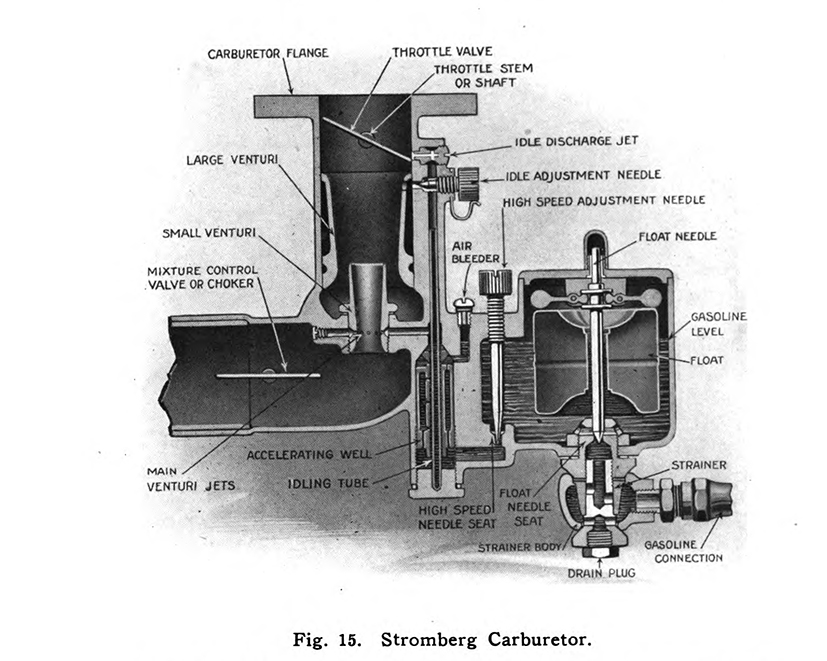
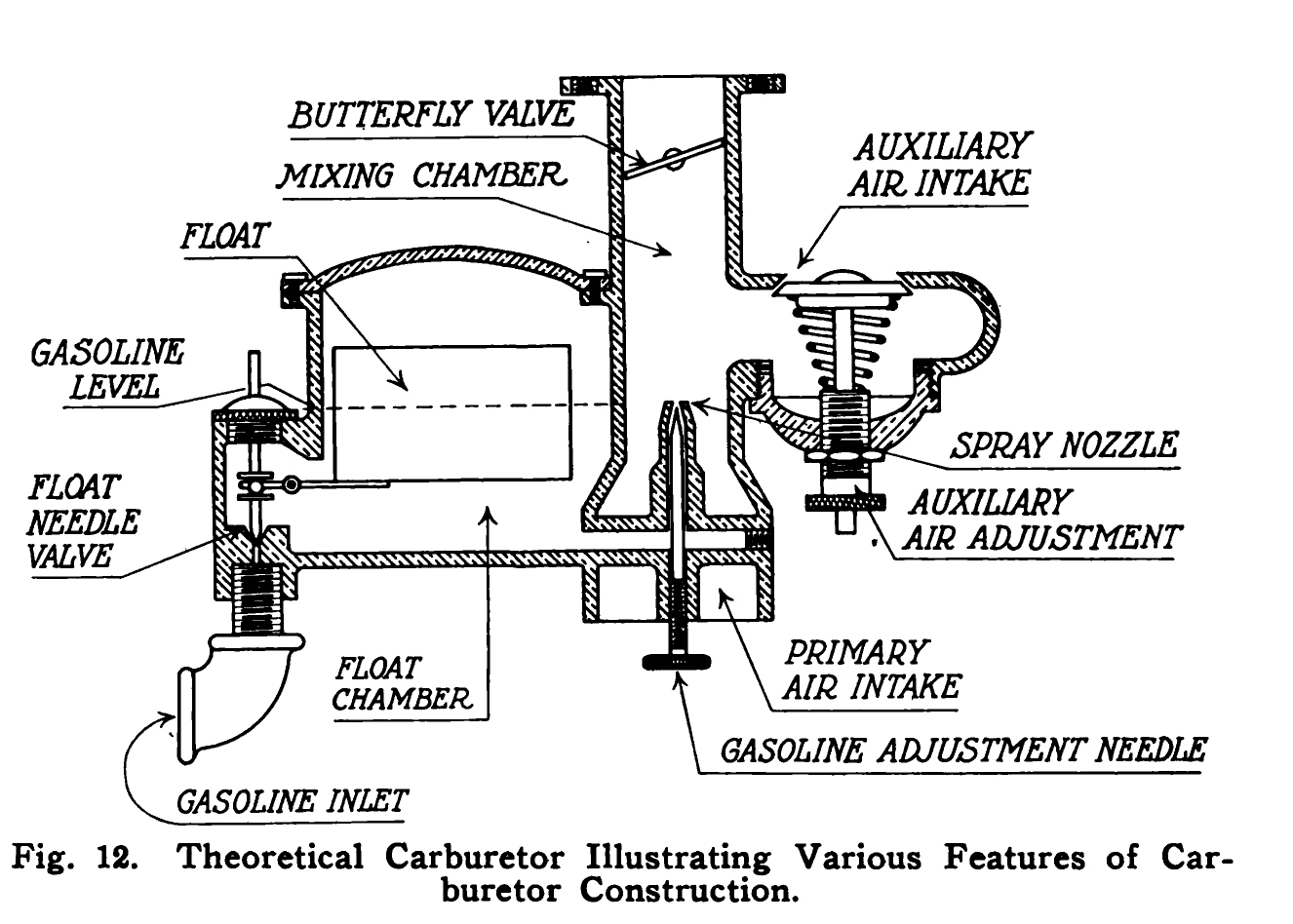
The suction created by the downward motion of the engine pistons draws air into the mixing chamber through both the primary and auxiliary air inlets. When the butterfly valve is nearly closed, most of the air enters through the primary inlet. This air is drawn into the mixing chamber around the spray nozzle, the vacuum thus created sucking gasoline from the nozzle which mixes with the air in the form of a spray. This action is similar to the ordinary atomizer in which the air forced from the rubber bulb picks up a certain amount of the liquid and sprays it out in the form of fine vapor. The primary air inlet is not large enough to permit a sufficient volume to pass to supply the engine at high speed, therefore a second air inlet, known as the auxiliary or automatic, comes into action whenever the vacuum in the mixing chamber is sufficient to overcome the tension on the spring.
At low speed, when only a small amount of air is being drawn through the carburetor, the spring holds this valve almost shut. As the
speed increases and more air is needed, the suction operating against the tension of the spring, draws the valve further and further open, giving an increased supply of air in exact proportion to the amount needed for the increase in speed. The carburetor thus automatically produces the correct mixture for all engine speeds.
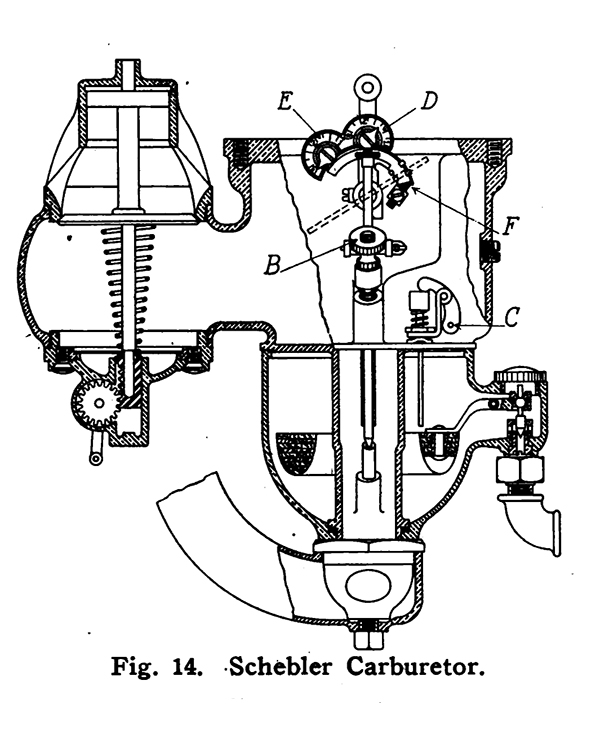
Some makes of carburetors are also constructed with two spray nozzles, the second one coming into action through a mechanical arrangement as the throttle is opened. The Rayfield uses two gasoline nozzles; the Stromberg, one. The Schebler has one nozzle in which is located a needle valve that lifts up by means of a cam as the throttle is opened, increasing the size of the o1 ening, so that a larger amount of gasoline is combined with the air at the higher speeds.
The carburetor device for producing mixture gasoline vapor and air the correct proportion for complete combustion.
It consists of: (1) the float chamber which regulates the flow gasoline have regular and constant supply for engine speeds, (2) the mixing chamber which the gasoline vapor mixed with air the proper proportion, (3) constant primary intake where the air used for low engine speed enters, (4) the automatic or secondary air intake where additional air for high engine speed enters, (5) the butterfly valve for controlling the amount of vapor entering the engine.
The general principles upon which most carburetors operate are the same, and the following description of action applies to carburetors in general. Detail directions for the adjustment of Schebler, Stromberg, and Rayfield carburetors are given at the end of this chapter.


Primer
On all carburetors used on Seagrave apparatus, excepting Stromberg, a priming lever is fitted which is connected by a wire to a ring on the front of the dash. By pulling out on this ring, the gasoline float needle is raised from its seat allowing the carburetor to flood or overflow. This is an advantage when starting in cold weather, the first mixture being drawn into the carburetor is then almost pure gasoline, and as gasoline does not vaporize readily in low temperature easier starying is secured.
This primer also valuable when locating trouble caused by the stoppage of gasoline between the carburetor and tank, such as frozen line or empty tank.
When using the primer to flood the carburetor, previous to starting. starting, it is better pull steadily than by quick jerks. No benefit derived from continuing this after the gasoline has entirely filled the float chamber.
Throttle Valve
The throttle valve, which is of the butterfly or shutter type, is placed just above the mixing chamber. It is connected by rods to both the hand throttle and foot accelerator. This valve has nothing to “do with the quality of the mixture, but controls entirely the quantity. When the engine is being operated at low speed, this valve is nearly closed, and the reduced speed of the engine is because of starvation.
Hand Throttle
The longer of the two levers on ‘top of the steering wheel controls the throttle. Moving this lever upward around” the quadrant increases the speed of the engine by admitting more gasoline mixture; while moving it downward decreases the speed by admitting less.
Foot Throttle or Accelerator
On the floor board at the right of the clutch pedal is a small foot throttle or “accelerator,” which is operated by depressing it with the right foot, giving the same control over the speed of the engine as by manipulation of the hand throttle lever.
Use of Hand Throttle and Accelerator
We recommend that the hand throttle be used in the majority of cases, but the accelerator is fitted for the use of those who prefer this control. Pressing the accelerator downward for increas ing the speed, or releasing it for decreasing the speed, gives instantaneous action. When the accelerator is not in use, the engine speed is governedby the position of the hand throttle lever on the steering wheel. Experienced drivers usually set the hand J throttle to give an average speed, then for any additional speed desired, the foot accelerator is used. As soon as the pressure on the accelerator is released, the speed of the engine returns to the minimum allowed by the hand throttle while in the set position. Although either the hand throttle or accelerator pedal may be used to control the speed of the engine, beginners are advised to confine themselves to the use of the hand lever. After the operator has gained confidence in his ability, the foot throttle may be experimented with. A great deal of injury may be done to a car by suddenly pressing down on the accelerator, as this causes the engine to suddenly develop a large amount of horse power which cannot be instantly applied to the car, as it takes time to get the heavy load under way. During this time, the transmission and other parts of the car are absorbing the excess power, thereby being needlessly abused.
Starting and Stopping
Before starting engine whencold, observethe following instructions: Open throttle not more than one quarter, (if opened more, starting will be difiicult) enrich the mixture by pulling up dash control; prime carburetor well by pulling on primer lever “G” for a few seconds. When stopping engine, pull up dash control. Open the throttle about one quarter and switch off ignition. This leaves a rich mixture in engine which insures easy starting.
General Information
The art of carburetor adjustment is something that must be learned by experience. A few minutes tinkering by a novice may undo the work that it took an expert half an hour to accomplish. Do not change the carburetor adjustment until after all other causes that might have a bearing upon the trouble have been given consideration. The float level is correctly set at the factory. Do not touch it under any circumstances. Remember that the low speed adjustment is to be used only when the engine is running idle, and positively must not be used in adjusting high nor inter mediate speeds. The float chamber should be drained occasionally through drain cock at the bottom to remove water or sediment which has accumulated. All Rayfield carburetors are equipped with a strainer trap at bottom of float chamber. To clean trap, shut off the gasoline and remove nut “S.” The gauze may then be easily removed and cleaned. In replacing trap, be sure that the nut is drawn up firmly to insure a tight joint. The trap can be drained by
shutting off the gasoline supply and removing small plug. If proper attention is given to the filter in the gasoline line, it will seldom be necessary to clean the trap in the float chamber.