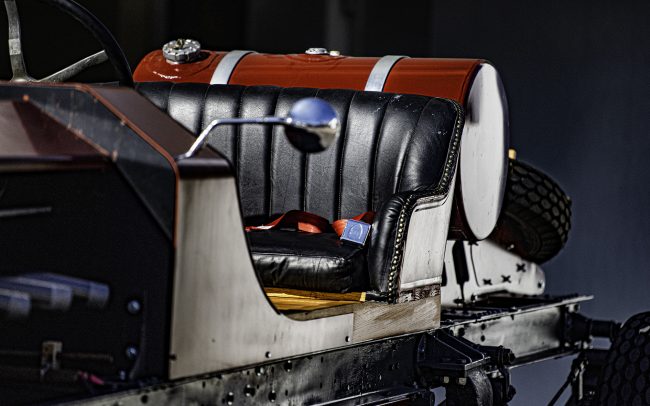
101 years, 1001 miles and a story worth to share….
Seagrave Chain Drive Transmission
The purpose of the transmission is to control the power of the engine so that the car can be driven successfully under all conditions. It changes the high speed of the engine into power or low speed for climbing grades and pulling thru heavy going. It changes the powerof the engine into car speed when this is desired. also, provides means for reversing the car. All this done means three separate gear ratios for the forward speeds and one for the reverse.
The transmission the selective sliding gear type. This means that the gears slide back and forth the sliding gear shaft and that the operator can mesh the gears for any speed selects without passing thru any the other speeds.
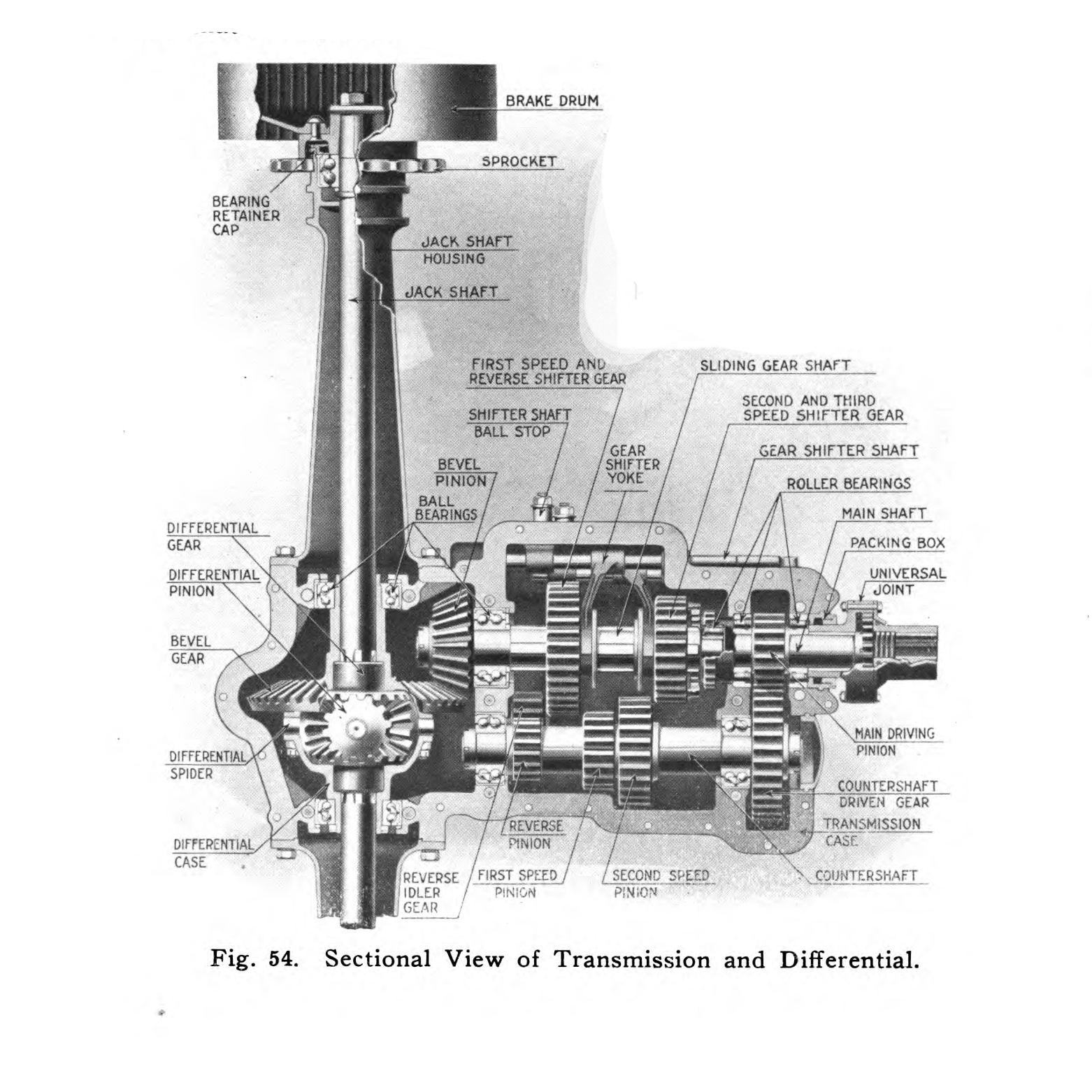
Figure 54 shows the construction of a selective type transmission.
The gears in the transmisslon are mounted upon three shafts, the transmission main shaft, the transmission sliding gear shaft, and transmission countershaft.
It would appear at first glance that the transmission main shaft and the sliding gear shaft were one, but such is not the case. Further examination will show that the forward end of the sliding gear shaft is telescoped into the main shaft and is carried upon ball-bearings.
This permits the two shafts to operate independently. The main 4 shaft is connected to the clutch, it is also geared permanently to the countershaft. The sliding gear shaft has a bevel gear at the rear end which meshes with the large bevel gear attached to the differential housing. These two gears drive the jack shafts that convey the power to the double side chains.
When the car is standing still with the engine running and the clutch in, it will be seen that the main transmission shaft and the counter shaft are in motion, while the sliding gear shaft is stationary. Before the car can be moved, it is necessary to bring all of the gears to a stand-still in order that one of those on the sliding gear shaft can be meshed with a gear on the counter shaft. This is accomplished by throwing out the clutch. The gear shift lever is then moved into the low speed position. This slides the low speed shifter gear into mesh with the low speed counter shaft gear, then when the clutch is let in, power is transmitted from the engine thru the transmission main shaft to the counter shaft, then thru the counter shaft low speed gear to the low speed shifter gear, and, then, to the bevel gears. This causes the car to move forward at a speed dependent upon the speed of the engine, but on account of the great reduction between the engine and the rear wheels, not more than five miles an hour can be made, even if the engine is operating at its full speed. This speed is only used for heavy pulling and for starting.
After the car has been started in low speed and has attained some momentum, it should be placed in the second speed. This is accomplished by throwing out the clutch, returning the low speed reduction between the engine and the rear wheels, not more than five miles an hour can be made, even if the engine is operating at its full speed. This speed is only used for heavy pulling and for starting.
After the car has been started in low speed and has attained some momentum, it should be placed in the second speed. This is accomplished by throwing out the clutch, returning the low speed shifter gear to its neutral position and moving the second speed shifter gear from its neutral position into mesh with the second speed counter shaft gear. When the clutch is let in again, the car will move forward at an increased speed, even with the same engine speed, on account of the lesser reduction in gear ratio. The power is now being transmitted from the transmission main shaft to the counter shaft, thru the second speed counter shaft gear to the second speed shifter gear, and then to the bevel gears, the same as before.
It will be noticed that nothing has been said about bringing the counter shaft gear to a stand-still before shifting into the second speed. This was unnecessary because the car was in motion, therefore, the transmission sliding gear shaft, which is permanently connected to the rear wheels, was also revolving. The only precaution to be taken in making this gear change is to have the counter shaft revolving somewhere near the same speed as the sliding gear shaft so that the shifting of the gears can be made easily. This is something that must be learned by practice and experience.
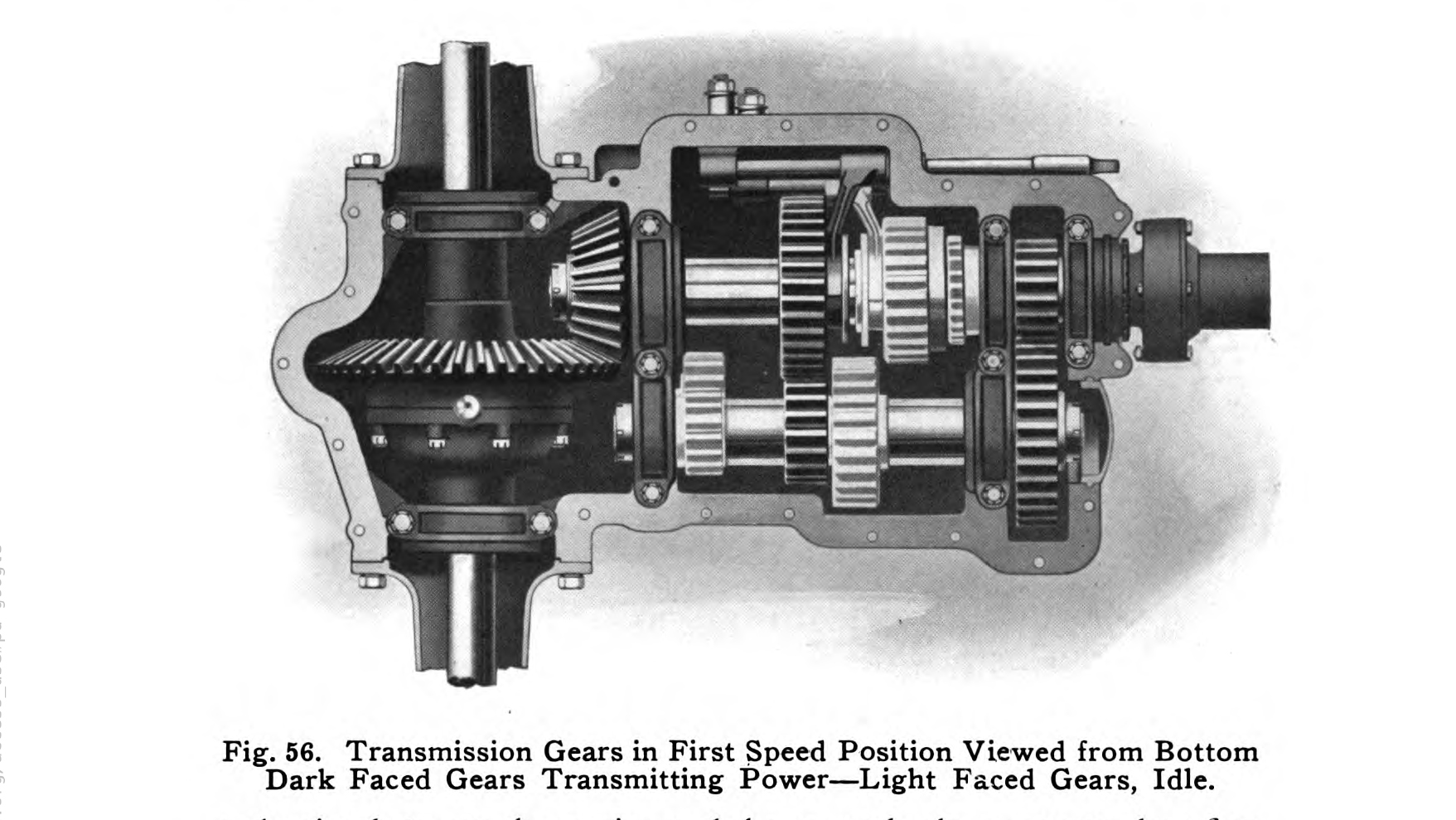
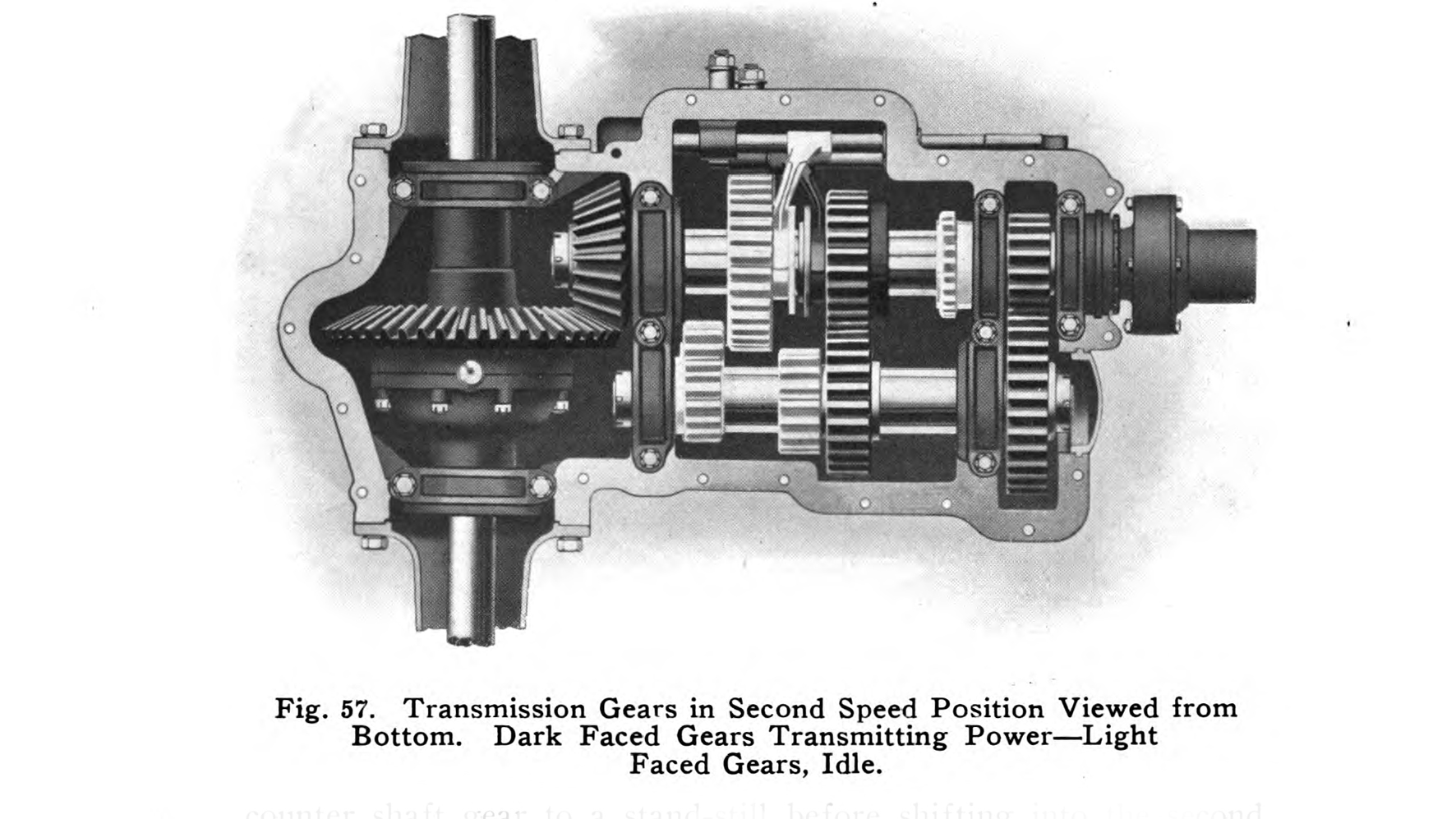
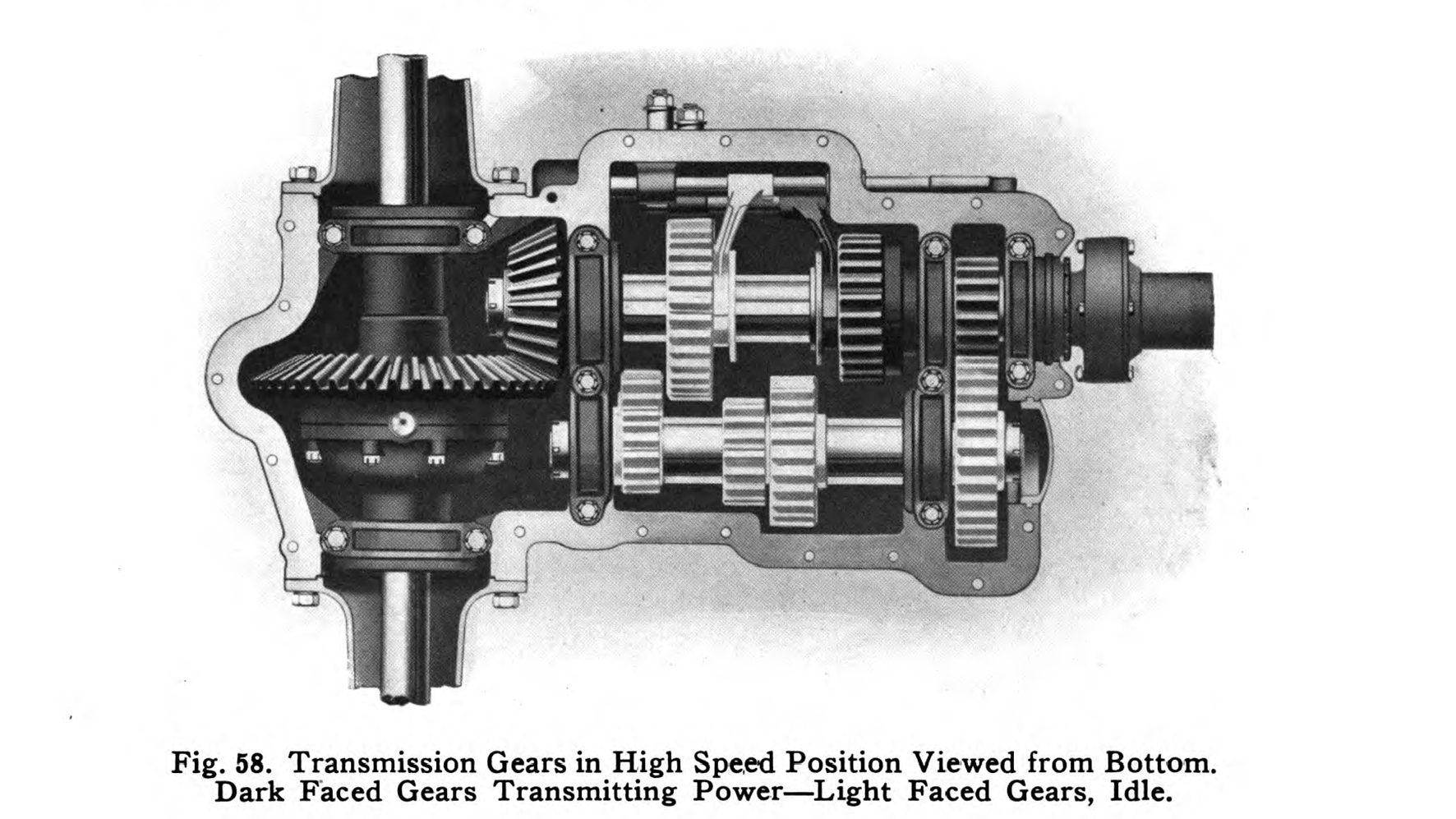
Ninety per cent (90%) of all driving is done on high or direct speed. During this time, the counter shaft is being driven from the transmission main shaft, but none of the shifter gears are in mesh with any of the counter shaft gears, so no work is done by it.
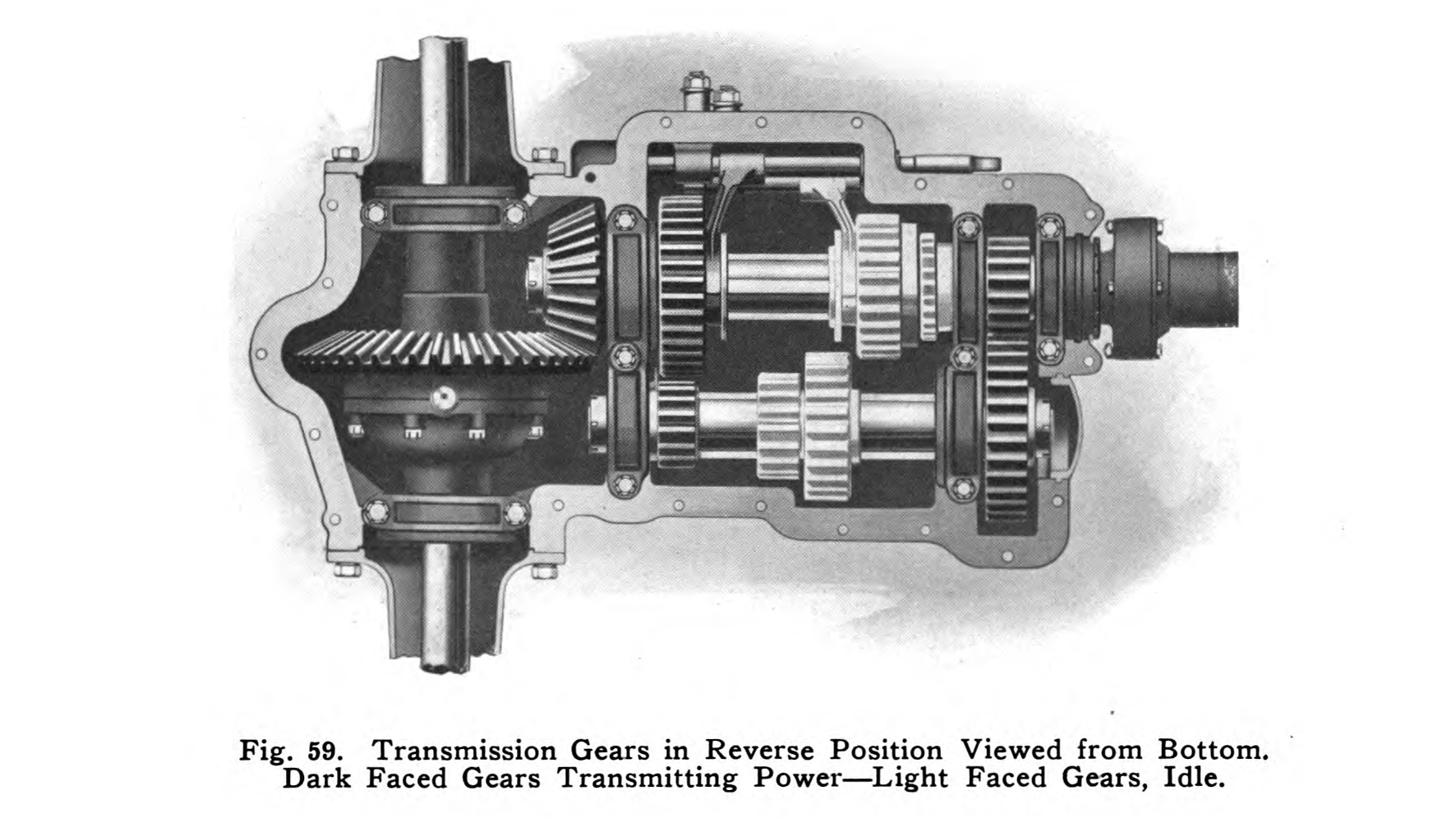
To shift the transmission gears into the reverse position, the clutch thrown out with the other speeds and the gear shift lever moved the reverse position. This moves the low speed and reverse sliding gear line with the counter shaft reverse gear, but these two gears do not mesh with each other. A third gear that is permanently in mesh with the countershaft reverse gear is mounted in the transmission case. It is with this gear that the sliding gear engages, and, when the clutch is let in, the car moves backwards, power being transmitted from the transmission main shaft to the counter shaft, then to the countershaft reverse gear, from it to the reverse idler gear and then to the low speed and reverse sliding gear, then to the bevel gears. The introduction of the reverse idler gear between the other two, reverses the direction of the sliding gear shaft and the bevel gears.
The Gear Change Control
The three forward speeds and reverse are obtained by movements of the one change speed or gear shifting hand-lever on the right hand side of the car. The method of making gear changes is described under “General Direction for Operation.” The lever moves in two directions, forward and back, in and out. The four positions of the lever to obtain the various speeds are shown in Fig. 2.
In neutral position (with no gears engaged) the lever is in the middle of the quadrant. It can be moved in and out across the center of the “I-I” slot to reach‘ any desired position.
In the first speed position, the lever is brought in towards the car and back to the end of the slot.
In the second speed position, the lever is pushed out from the car and forward to the front end of the slot.
In third or high-speed position, the lever is out from the car and at the rear end of the slot.
In reverse position, the lever is brought in towards the car and then pushed forward to the front end of the slot.
On the top of the lever, a button is located that connected with latch. This latch comes into contact with a stop upon the quadrant, making impossible to enter the reverse speed until the latch has been lifted. This safety device provided to prevent damaging the transmission gears by accidentally entering the reverse speed when shifting from low to second speed.
The gear shift lever, when moved in, engages with a finger on the end of the tube. This tube has a lever attached on the opposite end which connected with rod attached to the shifter yoke in the transmission, controlling the low speed and reverse sliding gear. When the gear shift lever moved out, engages with finger upon another tube that connected by a lever with the second speed and high-speed shifting gear.
Where these rods enter the transmission case, they are provided with notches, properly spaced, into which plungers, operated by springs, drop. These lock the gears into position so that they cannot move unless the gear shift lever is operated. When shifting any gear into mesh or out of mesh into the neutral position, the resistance of these locks can be felt. It might be well to add at this point that the gears can be shifted easily and it is not necessary to yank and strain at the shifting lever.
If the gears do not respond to a light pull, the operator is making the change unskillfully.
Always be sure to leave the gear shifting lever in neutral position when you stop the car.
Drive Chains
AAll drive chains used on Seagrave apparatus are of the detachable link type. Should a link be broken, it can be quickly replaced by a repair link.
The chains should be kept adjusted at all times; as they wear, they have a tendency to stretch.
The chains should be kept clean and well lubricated. The most wear in drive chains comes on the rivets, therefore, the most lubricant should be used on the inside. We recommend that oil be used for lubricating the chains in preference to grease. This oil can be mixed with graphite, if desired, with good results, and should be applied with a brush, to the inside of the chains, at least twice a month. Each time the car is used, wash the “drive chains with a rag moistened with kerosene to remove dust and dirt. Good care will do much towards lengthening the life of drive chains.
Adjustment of Chains
The chains should be adjusted from time to time to take up the stretch. This is done by removing the 5/8″ bolts at the front end of the radius rods, at the points where the radius rod screws enter the front yokes. Each radius rod adjusting screw is provided with two slots. In one of these, and held by the bolt, there is a key or lock, which can be removed as soon as the bolt has been taken out. The radius rod screw can then be backed out of the yoke by a large wrench upon the hexagon nut. Adjust each chain so that it will have about 2″ up and down movement. Be sure to turn the radius rod screws the same distance on each side, otherwise the rear axle will be thrown out of line.